The Lightyear Race

Earth, proudly twinned with Rigel, went the joke.

When intelligent life on Rigel was first discovered, it was a sensation. The newly christened Really Improbably Large Interferometer had just picked up on the barest traces of radio signals from the planet. In mystery, there was speculation, possibility, hope.

As investigation progressed, every bit of information was a revelation. Rigel has an oxygen atmosphere! Rigellians must have discovered radio pretty recently! Rigel must get fantastic meteor showers from a billion year old lunar collision!

But excitement dimmed to the brutal reality of physics. At 1137 light years away, Rigel was to be looked at, not touched. We scanned, and listened and analysed every scrap of information. We broadcast, lasered and launched every signal and probe, of welcome and jubilation. But that was the end of it, there was nothing left to do but wait. We had to make do with a millennium-old image of our neighbors, who couldn’t have even yet received any indication of Earth’s existence.

We quickly realized we were still alone in the universe. For what does “alone” mean, if not “no one to talk to”.

Continue reading →

Good Software Doesn’t Double Check

I’ve been wrestling with the balance between vibe coding and high touch manual coding these days. At the level of quality I’m trying to output, you cannot delegate everything to agents. But you want to do so as much as possible.

To do this effectively means developing a new set of coding smells. The original coding smells were quick tells of typical coding problems. They indicated muddled thinking, structural problems, or technical debt. But the sort of errors agents make are different and need a new set of nasal receptors. That is, for the next few months until a new crop of tools makes current wisdom obsolete again.

Continue reading →

Infinite Random Rectangles – the Poisson Rect process

Previously, we looked at how to sample points randomly at a given density across an infinite plane.

It’s harder than it sounds, as I was looking for an algorithm that was not biased by the size/shape of the chunks used to calculate it.

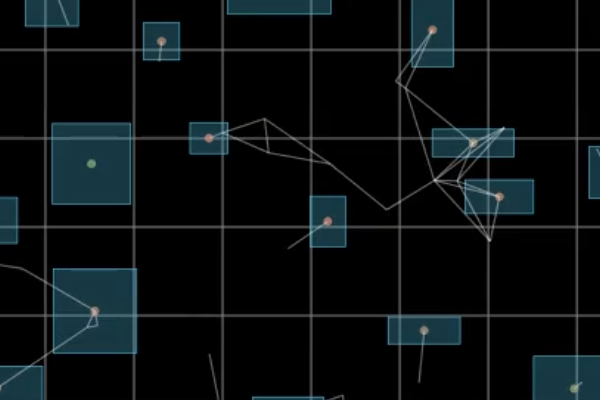
Today let’s extend that to filling the infinite plane with random non-overlapping rectangles. As before, that means finding a deterministic chunked algorithm that we can prove is unaffected by the choice of chunking.

Continue reading →