I’ve added an article on handling infinite sized procedural generation to the Sylves documentation. It’s probably of interest to readers of this blog as the techniques are fairly general.
infinite
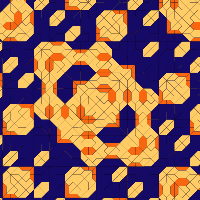
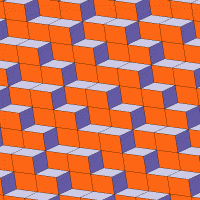
Infinite Random Rhombus Tilings
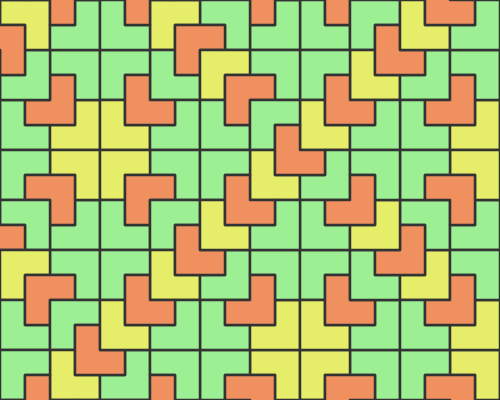
Everyone loves the Townscaper grid. It’s got a a nice organic look, while still being quadrilateral tiles, somewhat regular, and reasonably easy to implement. But it has some annoyances. I’ve finally managed to find my own design of grid that has a very similar look, but fixes these problems.
Continue readingSubstitution Tilings
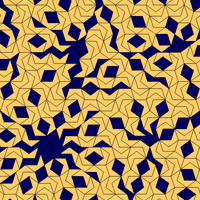
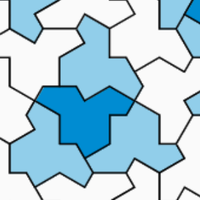
I’ve been working on adding aperiodic grids to Sylves.
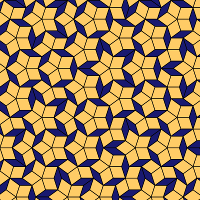
Aperiodic tilings are made tilings are made of a fixed set of tiles, rotated and translated to fully cover the plane.But they are not periodic – there’s no way to rotate/translate the whole grid onto itself.
This makes them almost hypnotic in their balance of regularity and chaos. A classic example is the penrose tiling.


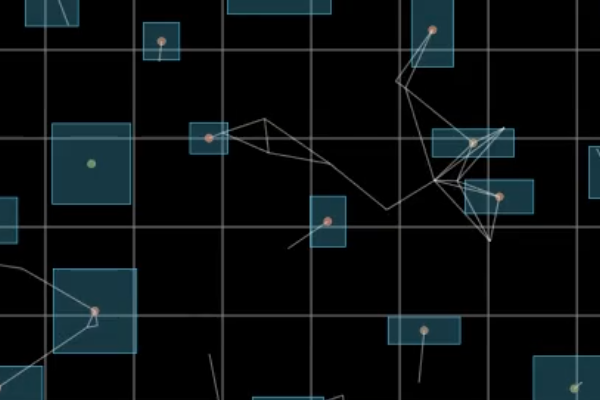
Infinite Uniform Point Distributions
Rune’s recent talk on layered procedural generation has got me thinking about procedural generation again, so I wanted to share a technique I found about doing a uniform distribution of points on an infinite plane. I assumed this would be a well known thing, but I couldn’t find any references elsewhere.
Continue reading0.999… = 1, with Rigour
I’ve recently seen a lot of demonstrations of why the decimal 0.999… equals 1.
These are endlessly cycling the internet, simply because all the simple explanations aren’t really compelling. You see smart people responding “can’t you just…” or simply not convinced by bare assertion.
The truth is that is that dealing with these things is actually a lot more complex than a glib twitter answer. You should feel uneasy with these explanations. This same subject confused mathematicians of earlier centuries, leading to awkward theories like “infinitesimals”, which ultimately fell out of favour.
I’m going to take you through a proof that 0.999… = 1, with rigour. Rigour is a term used in maths for building from a solid foundation and proceeding from there in sufficiently small steps. Thus, the majority of the article is not the proof but the definitions. How can we talk about infinity in a way that makes sense? The trick, as we’ll see, is to only talk about finite things we already understand, and define infinity in terms of those.
This article is aimed at those with high school level maths. There’s a proof halfway down, but it’s skippable.
Continue readingInfinite Quadtrees – Fractal Coordinates
A cool technique I’ve wanted to write up for a while is “Fractal Coordinates” described in a paper by Peter Mawhorter. Don’t be scared by the name, it’s essentially a variant on quadtrees that covers the entire 2d plane. Fractal coordinates have some interesting properties that are useful for procedural generation.
But first, let’s catch up on quadtrees.
Infinite Modifying in Blocks
I’m going to share with you a technique I’ve found for doing lazy, reliable, deterministic, constant-time infinite generation of tile based levels using Wave Function Collapse (WFC). But first, let’s cover some background, Modifying in Blocks, and lazy chunk based infinite generation.