Dihedral Subgroups Explained Via Factorio

The dihedral group is the mathematical formalism behind all the rotations and reflections of a regular polygon. For an n sided polygon, there are always n possible rotations, and n reflections, for 2n possible symmetries.

Combining any two symmetries gives another from the same group, that is what makes it a group in the mathematical sense.

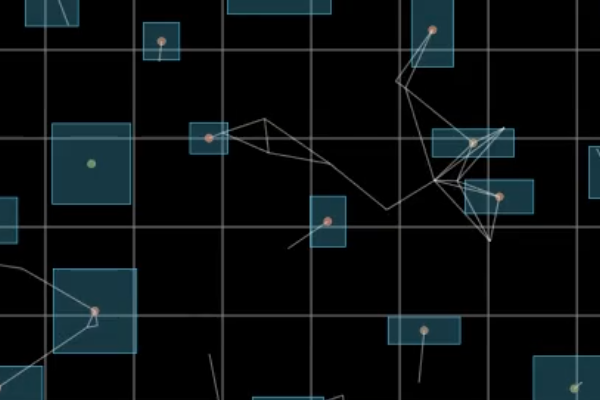
The theory of it is useful to know for gamedev. I was reminded of this when seeing this Factorio devlog, where the developer ran into some trouble because he initially forgot to account for all the cases.

Continue reading

Infinite Random Rectangles – the Poisson Rect process

Previously, we looked at how to sample points randomly at a given density across an infinite plane.

It’s harder than it sounds, as I was looking for an algorithm that was not biased by the size/shape of the chunks used to calculate it.

Today let’s extend that to filling the infinite plane with random non-overlapping rectangles. As before, that means finding a deterministic chunked algorithm that we can prove is unaffected by the choice of chunking.

Continue reading

Generating Tilesets with Stable Diffusion

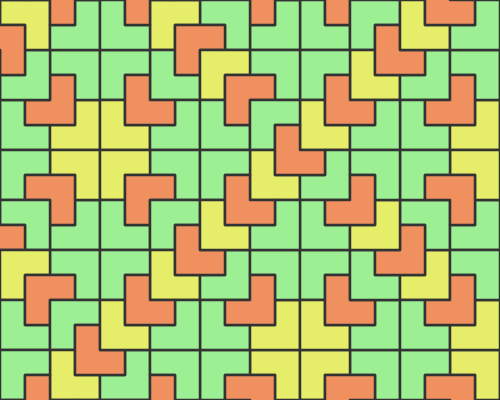
Recently I’ve been playing around more with gen AI techniques. I thought I’d try to generate a set of tiles that all connect together. It’s harder than it sounds – Stable Diffusion is hard to control, so there’s no easy way to get a set of images that are fully consistent with one another.

I’ve developed a technique for doing it that I’ll call Non-Manifold Diffusion as it involves doing diffusion over a set of patches that interlock to form a non-manifold surface.

Continue reading

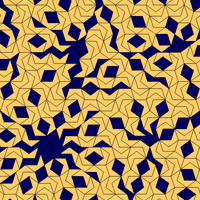
Substitution Tilings

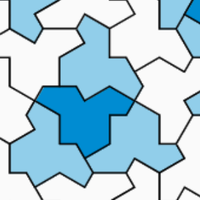
I’ve been working on adding aperiodic grids to Sylves.

Aperiodic tilings are made tilings are made of a fixed set of tiles, rotated and translated to fully cover the plane.But they are not periodic – there’s no way to rotate/translate the whole grid onto itself.

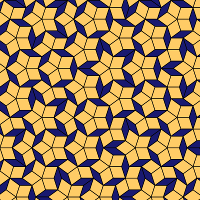
This makes them almost hypnotic in their balance of regularity and chaos. A classic example is the penrose tiling.

Continue reading

Quantum WaveFunctionCollapse

One of my biggest gripes with the WaveFunctionCollapse procedural generation algorithm is that, despite the name, it doesn’t really have anything to do with quantum mechanics. I usually prefer the term Constraint Based Procedural Generation instead.

The name WaveFunctionCollapse is meant more as an analogy. As the algorithm progresses, it resolves a fuzzy, uncertain picture of the output into sharper detail, much as in quantum mechanics, the state of a system is also a range of possibilities, which resolves to something specific when “observed”.

But could we adapt WFC to the Quantum way of thinking, and ran it on actual Quantum Hardware? Well, that’s exactly what is discussed in this new paper Quantum WaveFunctionCollapse by Raoul Heese1 (Youtube summary). Does it work? Is it fast? Let’s find out.

Continue reading