Rune’s recent talk on layered procedural generation has got me thinking about procedural generation again, so I wanted to share a technique I found about doing a uniform distribution of points on an infinite plane. I assumed this would be a well known thing, but I couldn’t find any references elsewhere.
Continue readinggamedev
RuleBook
I’m releasing a new open source library, RuleBook. Inspired by Inform 7‘s rulebook feature, it’s a way to make functions by defining a set of rules to evaluate. RuleBooks let you define functions are easy to mod and update at runtime.
What are rulebooks?
Rulebooks are essentially a fancy form of C#’s Func<> and Action<> generics.
Func<> and Action<> can hold a reference to a C# method, or an lambda expression/statement. But the thing they hold is essentially a black box – you cannot do much with it except run it, or check equality.
RuleBook provies FuncBook<> and ActionBook<>, which work similarly to their counterparts. But these rulebook objects are built out of individual rules, which can be individually inspected and mutated.
Overall, rulebooks give a systematic way of handling a bunch of useful programming patterns, including events, multiple dispatch, modding and code weaving.
Rulebooks are not an elaborate rules evaluation engine, it’s a lightweight way of stitching together bits of functionality.
PuzzleScript Rules
I was watching ThinkyCon, a conference on making puzzle games, and many designers mentioned that they use PuzzleScript to prototype their ideas. PuzzleScript is a puzzle design environment created by increpare, the designer behind Stephen’s Sausage Roll and many other puzzle games.
PuzzleScript is a marvel of economic design. A single text file specifies, all the graphics, levels, sound effects, and all the rules of the puzzle. It uses a custom system to concisely express rules. So concise that the rules of Sokoban can be expressed in a single line.
This efficiency comes because rules are expressed as find-replace rules. That makes it a grammar replacement system, which I last discussed when looking at Ludoscope and Unexplored. But it has many pragmatic features geared toward puzzle design, which I’ll explore in this article.
Continue readingWhat Is Procedural Generation
Procedural Generation can be interpreted quite broadly as just “making computers make cool creative things”. People make art, games, music, audio, stories and all sorts of weird things.
I’ve been doing it as a hobbyist for some time, and have become more and more involved: I make tutorials, projects, I sell a tool online for a niche algorithm, and recently taught a “masterclass” at Everything Procedural, the main conference for professionals in the space.
I thought I’d spill some digital ink about what it’s actually about. I get asked often enough, and this will help me clarify my verbal answers.
Continue readingPublishing An Open-Source Library for Unity
So you’ve got some open source C# code, and you want to publish it for other users in Unity? I’ve explored a few options, here are the pros and cons.
Continue readingGenerative Generators
This is a experiment I tried out for ProcJam 2023. I wasn’t getting great results from it and got bored after a few days, but I’ve decided to share what I did manage.
The rules of the hackathon were changed this year, ruling out most forms of AI. I was thinking – what’s the furthest I can push that rule without crossing the line?
In the end, I designed a system where we used AI to design and build a standalone classical generator.
Continue readingHow does Cave/Glade Generator Work
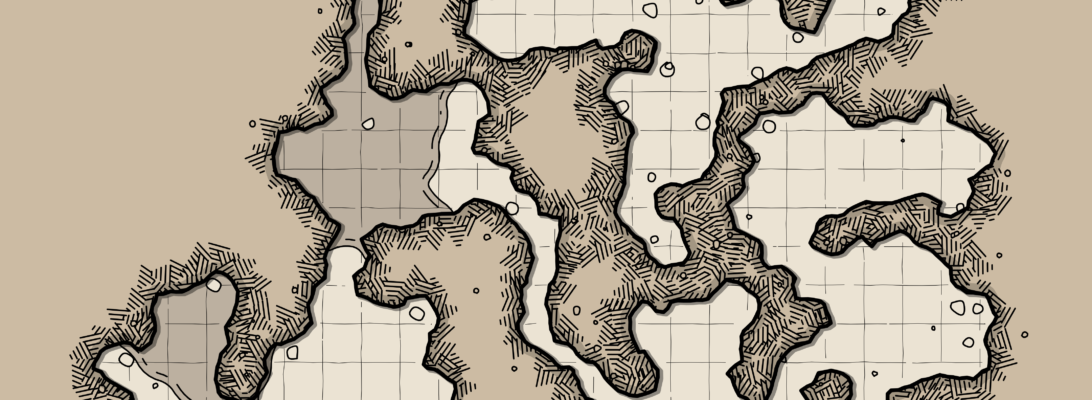
Watabou’s Cave Generator is one in a series of RPG-ready map generators that Watabou has created over the years. All his work oozes style, but the cave generator was always the one I found most mysterious.
I discovered that the entire thing was exported with extremely readable javascript, so naturally I started to poke and prod. Let’s go over how it works.
Continue readingWang Tileset Creator
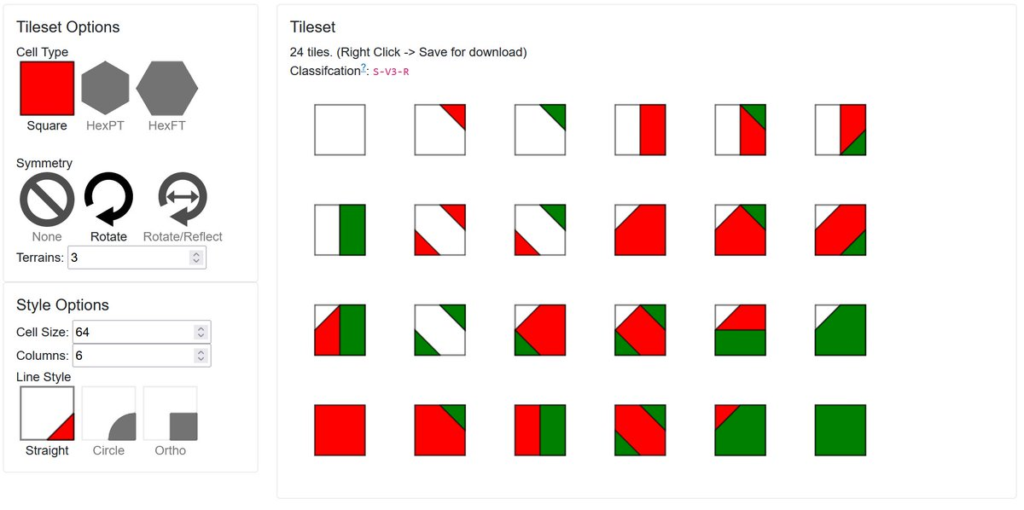
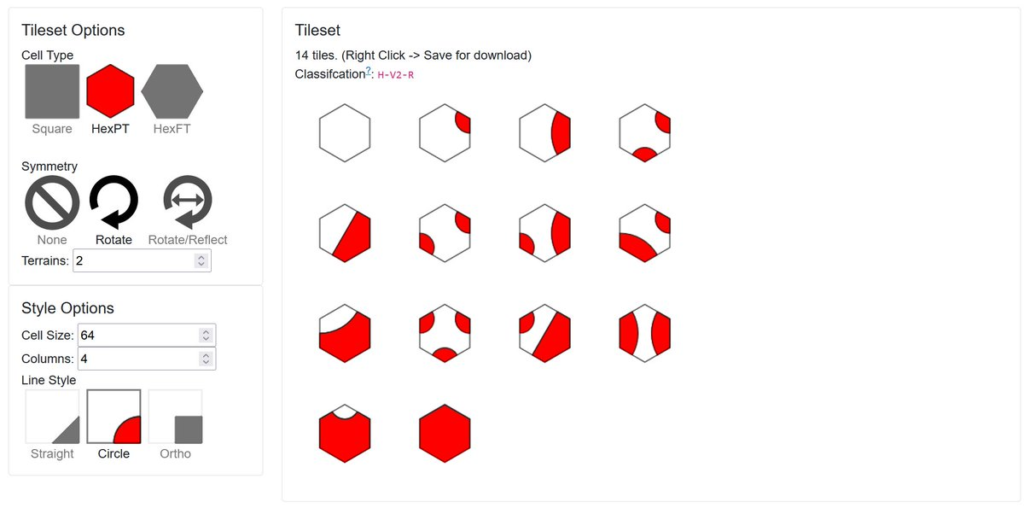
Ever struggled to figure out all the possible combinations of tiles you need to put together for autotiling? I’ve create a tool answers that question for a variety of cases, with visualizations.


Ortho-tiles
Last time, we looked at quarter-tiles. This was an auto-tiling technique for square grids. Each cell in the grid is associated with a terrain (i.e. either solid or empty). Then the squares were split in four, and each quarter was assigned an appropriate quarter-tile.
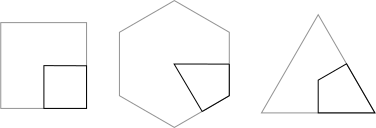
Otho-tiles extends this procedure to work with irregular grids, even non-square grids. We just have to alter the procedure a little, and be ready to deform the quarter tiles fit in place.
Ortho?
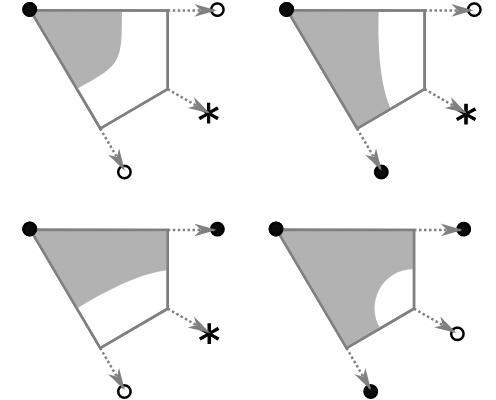
Ortho is a Conway Operator. It can be thought of as the extension of dividing a square into 4. It divides each n-gon into n “kites” or “ortho-cells”. Each kite is a four sided shape containing the cell center, one corner, and the midpoint of the two edges adjacent to that corner.
The appeal of the ortho operation is it can take any polygonal grid, no matter how irregular, and convert it into a grid of 4 sided shapes. And it’s much easier to work with something that has a consistent number of sides.
Continue readingQuarter-Tile Autotiling
Since Oskar posted about it, I see an increasing amount of praise for his Dual Grid proposal for autotiling terrains. It works by drawing tiles at a half-cell offset to the base grid, creating a dual grid, and using marching squares autotiling to select which tile to draw based on the terrains the corners of the dual grid, which is the centers of base grid.
This is a great scheme. It’s simple, only needs a few tiles and can be extended quite easily. It’s used in many games.
But, it does have some drawbacks. The dual grid is difficult to get your head around. You have to worry about ambiguous tiles. And despite being a substantial improvement over the blob pattern, it still requires drawing quite a number of different tiles.
I’m here to explain an alternative, quarter-tile autotiling. Quarter-tiling has also been called sub-tiles, meta-tiles (when doubling instead of halving). I’ve previous described as micro blob, which is the same thing with precomposition. It’s best known for being the tiling built into the RPG Maker engine.
Quarter-tiling is pretty easy to implement, and requires substantially less effort to create tiles for, as it uses fewer, smaller tiles. That does mean it’s not possible to produce as much tile variation as marching squares. But there’s plenty of techniques for adding that back.
Later, we’ll look at ortho-tiles – an extension of quarter-tiles to irregular, non-square, grids.
Continue reading