Quarter-Tile Autotiling

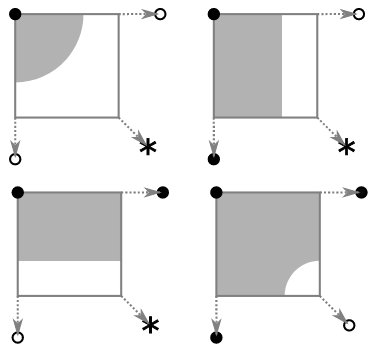
Since Oskar posted about it, I see an increasing amount of praise for his Dual Grid proposal for autotiling terrains. It works by drawing tiles at a half-cell offset to the base grid, creating a dual grid, and using marching squares autotiling to select which tile to draw based on the terrains the corners of the dual grid, which is the centers of base grid.

This is a great scheme. It’s simple, only needs a few tiles and can be extended quite easily. It’s used in many games.

But, it does have some drawbacks. The dual grid is difficult to get your head around. You have to worry about ambiguous tiles. And despite being a substantial improvement over the blob pattern, it still requires drawing quite a number of different tiles.

I’m here to explain an alternative, quarter-tile autotiling. Quarter-tiling has also been called sub-tiles, meta-tiles (when doubling instead of halving). I’ve previous described as micro blob, which is the same thing with precomposition. It’s best known for being the tiling built into the RPG Maker engine.

Quarter-tiling is pretty easy to implement, and requires substantially less effort to create tiles for, as it uses fewer, smaller tiles. That does mean it’s not possible to produce as much tile variation as marching squares. But there’s plenty of techniques for adding that back.

Later, we’ll look at ortho-tiles – an extension of quarter-tiles to irregular, non-square, grids.

Continue reading

Announcing Sylves

I’ve released a new library, Sylves that handles the geometry of grids for C# or Unity. I’ve basically distilled all my knowledge from several different grid projects, and made a solid base for anything you might want.

Defining Chess Piece Moves using Regular Expressions

Suppose you wanted to code a simple chess game. One key bit of game logic is to describe what are legal moves for each piece. There’s only 6 types of piece (pawn, knight, bishop, rook, queen, king) so this isn’t exactly a hard task. You can write rules such as:

def canRookMove(from, to):
  # Ignores questions about colliding with other pieces
  return (from.x == to.x or from.y == to.y) and from is not to

But these days, I’ve been thinking a lot about grids, and the above approach just doesn’t generalize. What if you wanted to play chess on a stranger grid?

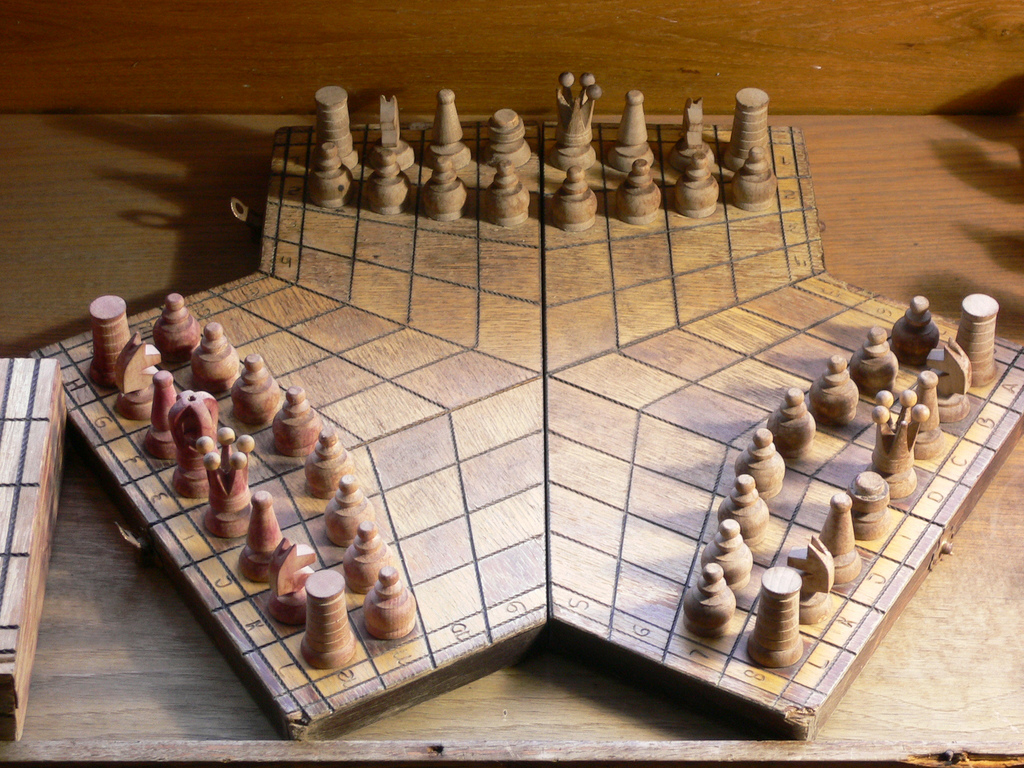
Three player chess (CC BY 2.0, source)

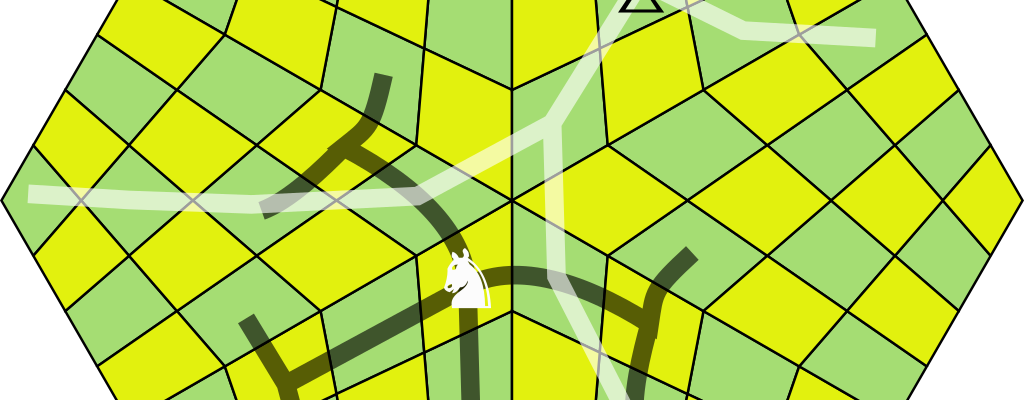
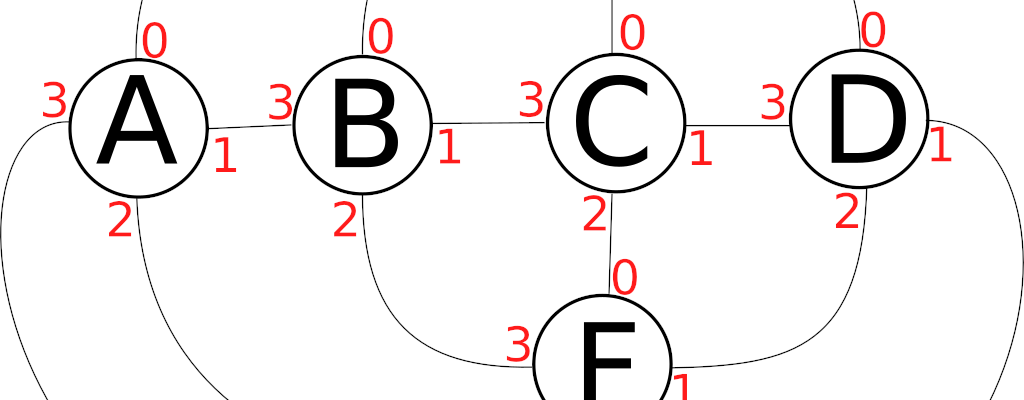
What would it mean to play chess on the grid above, or a hexagonal grid, and so on? You’d have to write a whole new set of rules, and they could get very complicated depending on the grid in question. What I want is a language that describes how pieces move, which generalizes to any board. And I think I’ve found it, using regular expressions.

Continue reading

VoronatorSharp

I’ve relased a new library, VoronatorSharp.

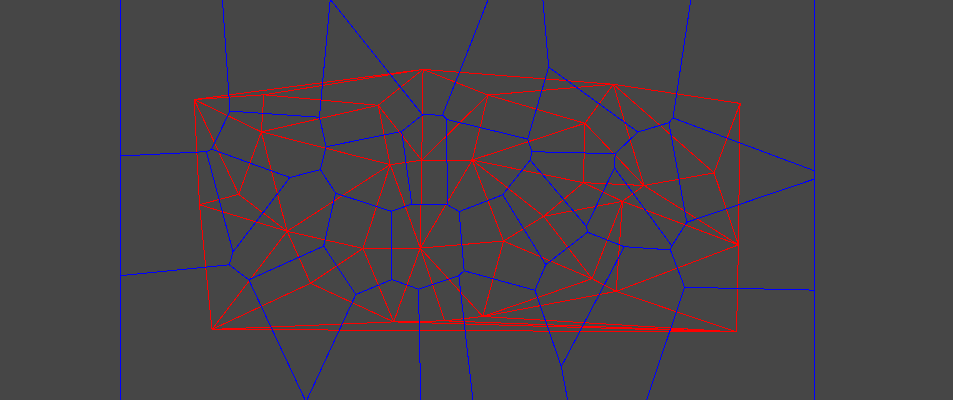
VoronatorSharp is a C# library that computes Voronoi diagrams. The Voronoi diagram for a collection of points is the polygons that enclose the areas nearest each of those sites.

Voronoi diagrams have applications in a number of areas such as computer graphics.

This library features:

  • Computes Voronoi diagrams and Delaunay triangulations.
  • Voronoi polygons can be clipped to a rectangular area.
  • Uses a n log(n) sweephull algorithm.
  • The implementation attempts to minimize memory allocations.
  • Integrates with Unity or can be be used standalone.
  • Uses robust orientation code.
  • Handles Voronoi diagrams with only 1 or 2 points, and collinear points.