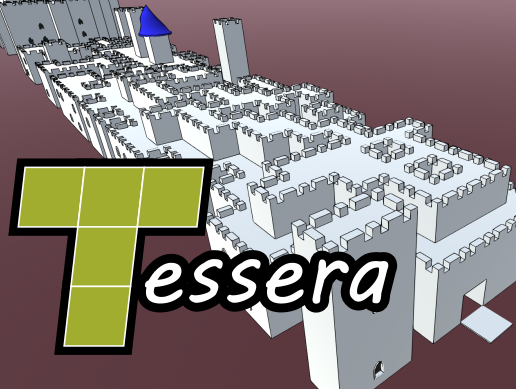
After a lot of work, I’ve prepared my first ever commercial release. It’s an addon for Unity that lets you procedurally generate levels and other things based on a simple tile setup.
gamedev
Dungeon Generation in Enter The Gungeon
I’ve been playing a lot of Enter The Gungeon recently. It’s a great, brutally hard, twin stick bullet hell that reminded me a lot of Binding of Isaac. But as I’ve been playing it more and more, I realized that the dungeon design actually shows some subtle genius.

There are many procedural generators out there that produce sensible level layouts that manage pacing and rewards correctly, and there are other generators out there that provide levels that include loops and compact layouts. But it’s hard to find both in a single game. Really, the only other game I’ve heard attempting this is Unexplored.
So, naturally, I broke out the decompiler to reveal all of Gungeon‘s secrets to me. I’ll share with you what I found.
Continue readingDungeon Generation in Diablo 1
Diablo 1 is a classic 1996 hack and slash action RPG. It was one of the first popular attempts at bringing roguelikes to the masses, from the niche ascii art. It’s spun a host of sequels, and imitators. It’s known for a dark, moody atmosphere that intensifies as the player descends into the dungeon beneath the town of Tristram. It was one of the first games I played with procedurally generated maps, and it blew me away that generating such convincing areas was even possible.
I recently discovered that thanks to the discovery of various debug symbol files accidentally left lying around, several fans took it upon themselves to reverse-engineer the source code and clean it up into a good guess at what the original game is like. Thus began a week long deep dive into how exactly did lead developer, David Brevik, actually craft these levels. It may have taken away some of the magic of the game, but I learnt lots of techniques I think are applicable to anyone developing a similar game, which I share with you below.
DeBroglie v0.1
Introducting my latest project, DeBroglie.
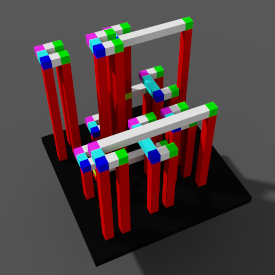
DeBroglie is a C# library and Windows command line application implementing the Wave Function Collapse algorithm with support for additional non-local constraints, and other useful features.
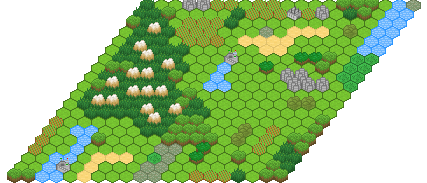
Wave Function Collapse (WFC) is an constraint-based algorithm for which takes a small input image or tilemap and procedurally generating a larger image in the same style, such as.
DeBroglie is stocked with loads of features to help customize the generation process.
Basically, you can use it to generate cool tile based stuff.
Barycentric Perlin Noise
Perlin noise is a classic procedural texture. It gives a wavy grayscale image, that has all sorts of uses in computer graphics. Commonly, it’s used to blend two textures together.

But what if you want to blend three or more textures together? Well today I have the answer.
Continue reading
Random Paths via Chiseling
I went over a previous project to randomly generate paths between points and came up with a much more efficient and versitile algorithm.
(EDIT: In 2022 I found an even better way.)
The algorithm is simple. Start with the entire area covered in path tiles, then and remove tiles one by one until only a thin path remains. When removing tiles, you cannot remove any tile that will cause the ends of the path to become disconnected. These are called articulation points (or cut-vertices). I use a fast algorithm based on DFS to find the articulation points. I had to modify the algorithm slightly so it only cares about articulation points that separate the ends, rather than anything which cuts the area in two. After identifying articulation points it’s just a matter of picking a random tile from the remaining points, and repeating. When there are no more removable tiles, you are done. Or you can stop early, to give a bit of a different feel.
I call it “chiseling” as you are carving the path out of a much larger space, piece by piece.
See on github .
Continue reading
Dual Contouring Tutorial
Marching Cubes 3d Tutorial
In the first article I showed how the Marching Cubes algorithm works in 2d.
In this tutorial, I cover how it can be extended to 3d.
Continue reading
Marching Cubes Tutorial
In Minecraft, you can dig in any direction – removing a block at a time with well defined edges. But other games manage to destruct terrain smoothly, without all the blockiness of Minecraft.
The following tutorial in Marching Cubes, a technique for achieving destructible terrain, and more generally, creating a smooth boundary mesh to something solid. In this series, we’ll cover 2d in this first article, follwed by 3d in the next , and Dual Contouring in the third. This last is a more advanced technique for achieving the same effect.
Celtic Knots 1.0 – Now with Twills
I’ve just released a new update for an old blender addon, bumping the version to 1.0.
The addon can now generate a much wider variety.
Check it out on github.