Quarter-Tile Autotiling

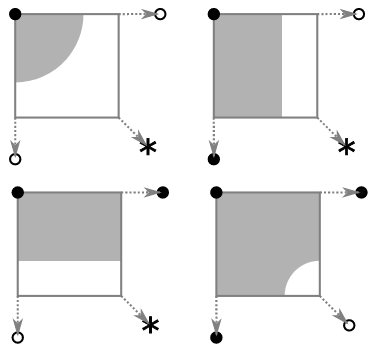
Since Oskar posted about it, I see an increasing amount of praise for his Dual Grid proposal for autotiling terrains. It works by drawing tiles at a half-cell offset to the base grid, creating a dual grid, and using marching squares autotiling to select which tile to draw based on the terrains the corners of the dual grid, which is the centers of base grid.

This is a great scheme. It’s simple, only needs a few tiles and can be extended quite easily. It’s used in many games.

But, it does have some drawbacks. The dual grid is difficult to get your head around. You have to worry about ambiguous tiles. And despite being a substantial improvement over the blob pattern, it still requires drawing quite a number of different tiles.

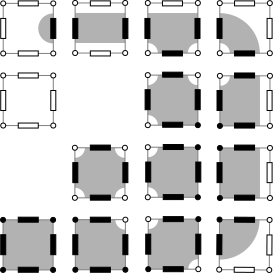
I’m here to explain an alternative, quarter-tile autotiling. Quarter-tiling has also been called sub-tiles, meta-tiles (when doubling instead of halving). I’ve previous described as micro blob, which is the same thing with precomposition. It’s best known for being the tiling built into the RPG Maker engine.

Quarter-tiling is pretty easy to implement, and requires substantially less effort to create tiles for, as it uses fewer, smaller tiles. That does mean it’s not possible to produce as much tile variation as marching squares. But there’s plenty of techniques for adding that back.

Later, we’ll look at ortho-tiles – an extension of quarter-tiles to irregular, non-square, grids.

Continue reading →
Learning to Finish Things

For many years I was a hobbyist programmer. I’d try out small projects, experiment, then move on to the next thing. This was a great way to learn a lot, but I’ve got almost nothing tangible to show from that era. Despite the best of intentions, every project reached a point where it started to drag, and I’d get bored and move on.

It was only a problem for the projects I worked on myself. Working for others, I never really found the same problems. It was a problem of motivation and focus.

More recently, it is different. Now when I start hobby projects, there’s a good chance I’ll cross that finish line, and have something I’m ready to share with the world. What changed? Well in part it is increased experience and maturity, things I cannot teach. But also, I have found some strategies and thought processes helpful, and other, very tempting ones, not so much.

In short, I’ve learned to finish, which is a real skill you can learn over time. I thought I’d share with you what has worked for me. Maybe it’ll work for you too. I make software, but I think this advice is generally true for any other spare time activities. There’s three sections – scope, motivation and distractions.

Continue reading →

Editable WFC

When I spoke about autotiling, I briefly touched on how it’s possible to use Wave Function Collapse (or other constraint based generators) as a form of autotiling, i.e. user-directed editing of tilemaps.

I’ve usually referred to this technique as “editable WFC“. It’s a combination of autotiling and WFC, and contains the best of both:

  • Being an autotiler, it allows users to easily and interactively make changes to an existing level.
  • Being constraint based, it automatically ensures that those changes are consistent with the predefined rules of the constraints, potentially making further changes to the level to make it fit

This is different from most other autotilers, which either require manual configuration of patterns used to enforce good behaviour, hidden layers, or come with more stringent requirements on what tiles are available.

Continue reading →

2d Marching Cubes with Multiple Colors

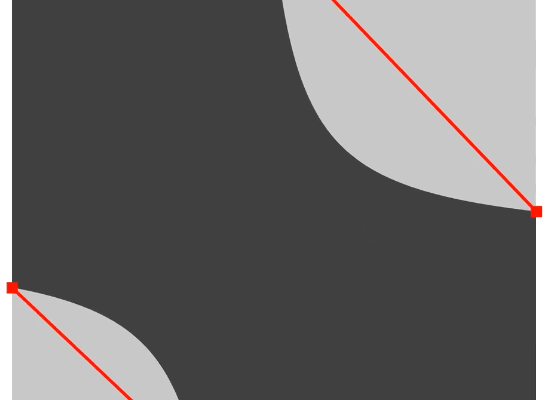
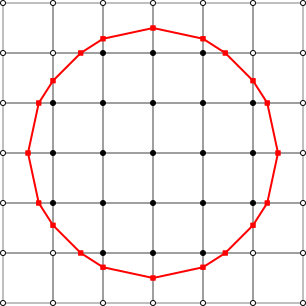
2d Marching cubes (sometimes called marching squares) is a way of drawing a contour around an area. Alternatively, you can think of it as a drawing a dividing line between two different areas. The areas are determined by a boolean or signed number value on each vertex of a grid:

But what if we didn’t have a boolean value? What if we had n possible colors for each vertex, and we wanted to draw separating lines between all of them?

Continue reading →

Classification of Tilesets

Many years ago I started looking at different sorts of tiles sets used by artists. A good tile set is flexible enough to allow tiles to be re-used in a lot of situation, but simple enough that the tiles can be easily created. Ideally, it would enable autotiling or otherwise be easy to design levels with.

Though I covered a few different techniques back then, I fell short of any systematic discussion of tiles. Here I plan to take a more rigorous approach, in the hopes of making a common language for referring to different tile sets, and pointing out the key variations in design. Maybe we’ll even discover something new, like Mendelev predicting new elements for the periodic table.

You can explore many of the tilesets discussed using the Tileset Creator tool I made.

Continue reading →

Constraint-Based Tile Generators

Last article, we were comparing WaveFunctionCollapse (WFC), and Model Synthesis (MS). These are both similar procedural generation techniques that work along similar lines. Specifically, they generate a grid of tiles (or pixels), using a set of hard constraints, and some generalized solver technique to find a solution, a set of tiles that satisfies all the constraints provided. Let’s call this overall class of thing constraint-based tile generators.

The techniques have been pretty popular in recent years, and part of that is because it’s actually a very easy concept to experiment with and extend. Many of the more practical examples in the wild include their own extensions, as basic WFC tends to produce levels that look a bit repetitive and structureless.

Today I thought I’d do a review of all the different ways that you can customize this generation technique, showing how WFC and MS are subsets of a greater class. The whole family of such algorithms is much larger and I think there’s a lot of potential still to explore.

Continue reading →

Model Synthesis and Modifying in Blocks

I’ve written a lot about Wave Function Collapse. Developed in 2016 by Maxim Gumin, it’s an algorithm for generating tilemaps and pixel textures based on the constraint solving with extra randomization . But did you know most of the key ideas come from a paper written a full decade earlier? Today, we’ll be looking into Model Synthesis, the 2007 PhD dissertation of Paul Merrell, and some of the elaborations he’s designed, particularly Modifying in Blocks.

Continue reading →